Kevin Desmond’s book on Gustave Trouvé represents a very detailed review about the work of this brilliant nineteenth century French electrical entrepreneur. From birth to death, in a strictly chronological order, Desmond presents all and every one of the 75 inventions and innovations conceived by Trouvé all along his life, including the electric polyscope (the prototype of today’s endoscope), the electric tricycle, the electric dental drill, the portable electric safety lamp, the electric rifle, the battery-powered headlamp, or the auxanoscope (ancestor of the modern overhead projector).
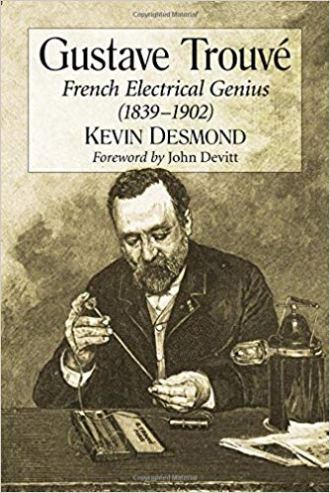
The book is divided in nine chapters and includes two appendices. Except of the last chapter, the first eight chapters somehow matches some very well defined periods in Trouvé’s life.
Chapter one reviews the birth and growth of Trouvé at his hometown in La Haye-Descartes, under the wing of a bourgeois family.
Chapter two comes to the move of Trouvé to Paris at the age of 20, where he started his labour career in a clock and watch workshop and quickly gained a good reputation as a very much skilled person able for “made-to-order mechanic, electrical appliances”, as he described to himself.
Chapter three shows a Trouvé fully dedicated to the invention activities and leading a team of about a dozen people working in his own workshop at number 14 of Vivienne street, in the second district of Paris. It was running the year of 1878 and the telephone and the electric motor were the new amazing technological sensations. Trouvé took part in the improvement of both devices by conceiving several noteworthy innovations.
Chapter four refers the increasing interest of Trouvé for the electric lamps and on the supplying of electric lighting to domestic houses. It was the time when he fully devoted to the manufacture, promotion and copycatting of the “photophore”, a very well developed prototype of a modern battery-powered frontal headlamp made on 1883. As a curiosity, in this period he also turned his attention to lamp-stand designing where he ingeniously came up with hybrid lamps, which could work either using candles or electric bulbs.
By following that direction, in next years, Trouvé improved the safety of his “photophore” and extended its application to different fields of human activities, like underwater repairing and exploration or the inspection of geological layers, and moved his interest to not yet explored markets like arts, by creating different pieces of electro-mobile and electric light jewellery for stage props and costumes; decoration, by building amazing luminous fountains and mechanical birds; instrumentation, by transforming old fashion mechanic instruments to electric operated ones, like the electric gyroscope, the electric tachometer, or the pedal-operated electro-cautery device; or entertainment, by making electric toys, like his amazing “ornithopter” (a flying bird operated similarly to a helicopter), or his electric keyboard instrument based on Savart’s wheel. All these advances are part of chapters five to seven in Demond’s book.
Last years in Trouvé’s life are finally reviewed in chapter eight. In 1902, Trouvé was working on his latest innovation, a small portable device which used ultra-violet light to treat skin diseases, when he accidentally cut his thumb and index fingers. Neglecting the wound, septicemia set in and after amputations at the Saint-Louis Hospital, Paris, the 63-year-old inventor died on July 27, 1902.
Available from Amazon.com in paperback copy (218 pages).
 Antonio Perez Yuste